
Philosophy, Religion & Ethics (PRE)
Vision
The mission of the Piggott School Philosophy, Religion & Ethics Department is to nurture young people, so they grow into deep Critical Thinkers, life-long Reflective Learners, caring Good Samaritans, and empowered Courageous Advocates.
We view this as a process.
Firstly, students engage in analysis, evaluation, discussion, and debate of the philosophical, ethical, and theological issues of the present day. This enables them to grow as Critical Thinkers. This leads the students to a place of self-reflection.
Through intentional classroom-based activities, we nurture our students to become lifelong Reflective Learners. We believe this approach develops a compassionate response to ourselves and the world around us. This enables students to combine the topical learning with the school’s vision from Luke 10:25 – 37 to become caring Good Samaritans who embody a spirit of love and mercy to themselves and those around them.
In doing so, we plant the seed of empowerment, giving the students the opportunity to use their evaluation, reflection, and agape for others to respond with Courageous Advocacy to the ethical issues of the day.
Curriculum Impact:
June 2025 Results:
Year 10 AQA GCSE RE:
221 Entries:
|
% 9 |
% 9-7 |
% 9-5 |
% 9-4 |
% 9 - 1 |
|
14 |
43 |
80 |
89 |
100 |
Year 13 OCR A Level Religious Studies:
12 Entries:
|
% A* |
% A* - A |
% A* - C |
% A* - E |
|
17 |
33 |
58 |
100 |
June 2024 Results:
Year 10 AQA GCSE RE:
212 Entries:
|
% 9 |
% 9-7 |
% 9-5 |
% 9-4 |
% 9 - 1 |
|
13 |
41 |
75 |
86 |
99 |
Year 13 OCR A Level Religious Studies:
12 Entries:
|
% A* |
% A* - A |
% A* - C |
% A* - E |
|
27 |
46 |
82 |
100 |
June 2023 Results
Year 10 AQA GCSE RE:
197 Entries:
|
% 9 |
% 9-7 |
% 9-5 |
% 9-4 |
% 9 - 1 |
|
12 |
34 |
70 |
83 |
100 |
June 2022 Results:
Year 11 AQA GCSE RE:
201 entries:
|
%9 |
% 9-7 |
% 9-5 |
% 9-4 |
% 9-1 |
|
10 |
35 |
76 |
89 |
100 |
Year 10 AQA GCSE RE:
200 Entries:
|
%9 |
% 9-7 |
% 9-5 |
% 9-4 |
% 9-1 |
|
9 |
46 |
82 |
91 |
100 |
OCR A-Level Religious Studies:
9 Entries:
|
% |
% |
% |
% |
% |
|
22 |
56 |
89 |
100 |
100 |
Curriculum Intent
Our curriculum intent is founded on the Church of England Religious Education Statement of Entitlement for Church Schools and the Pan-Berkshire Agreed Syllabus for Religious Education 2018-2023.
Philosophy, Religion & Ethics at The Piggott School engages pupils in a rich, intellectual discourse about religious and non-religious traditions that have shaped Great Britain and the world. Pupils study the six major world religions and alternative religions. Pupils understand that in many areas of community life they are outsiders that need to understand how insiders might view their religion or world view and how that impacts their wider community.
PRE enables students to use a multi-disciplinary approach to tackling significant human questions of believing, behaving and belonging (as outlined in the Pan-Berkshire syllabus). Pupils use this to reflect on their own world view and meaning to life, and how that impacts their life and window into the world. Pupils are taken on a learning journey that involves substantive, multi-disciplinary and personal knowledge. This makes PRE a unique learning experience across the curriculum.
In line with the requirements of a Church of England school, pupils learn and understand Christianity as a diverse global living faith through the exploration of core beliefs and practices using an approach that critically engages with biblical text and the diversity within Christianity. Christianity is taught in a spiral manner, scaffolded in small steps, that allows pupils to gain a deeper understanding as they progress through school.
Philosophy, Religion & Ethics is an open-minded, big-hearted subject that promotes a tolerant yet rigorous discussion of religious and non-religious views on theological, philosophical and sensitive moral issues. Teachers model this approach, which allows pupils to personally reflect on and critically evaluate these views in a safe environment. All lessons begin with a review of previous learning, enabling students to understand and connect with the spiral curriculum, and most lessons conclude with a guided practice activity, enabling students to develop their higher order thinking skills.
PRE is taught with a strong emphasis on social advocacy and championing others, we incorporate topics and activities that enable pupils to flourish as reflective advocates in a modern, diverse Britain. PRE contributes to the cultural capital of every pupil in the school and plays a major role in The Piggott Schools’ spiritual, social and moral development programme. We want to give pupils from Year 7 to 13 independent and collective opportunities to ‘Go and do likewise.’
In other words:
- We want to facilitate reflection opportunities for our students in every lesson - on their learning, progress, and themselves, within our curriculum with a consistent approach across all types of assessment and topics. This will encourage our students to take more ownership and responsibility for their own learning. Reflection and peer/self-assessment activities in lessons will help students to grow to become independent learners and critical thinkers.
- We want to promote the importance of social advocacy, be imaginative in how we incorporate it into our SOWs and extra-curricular activities, and take a school lead on managing/initiating student engagement in wider issues
- We want to develop our outstanding PRE teaching and learning practices of GCSE exam skills throughout KS3 and KS4, maintain a consistent approach to lesson planning, homework and exam-style assessments and feedback, make use of internal and external CPD, incorporate ‘creative and challenging’ activities into most lessons, and help students achieve their full potential at GCSE exams.
How PRE at The Piggott School reflects the Church of England’s Statement of Entitlement:
PRE at The Piggott School meets the criteria laid out in the ‘Statement of Entitlement’ by the Church of England because:
- PRE is taught to every pupil from Year 7 to Year 12
- Every pupil receives 2 hours of PRE per fortnight from Year 7 - 9 with 4 hours per fortnight in year 10 to allow for early exam entry.
- Year 11 pupils receive 1 hour a fortnight of core PRE
- Year 12 pupils receive 1 hour a fortnight of core PRE
- All students take full course AQA GCSE Religious Education at the end of Year 10.
- OCR A Level Religious Education is part of the A Level provision at The Piggott School
- The RE curriculum is sequenced in a way that allows students to master the core skills and deep, substantive religious knowledge over the 6 years.
- The curriculum provides a rich discourse on a range of religions, including Christianity, Islam, Buddhism, Sikhism and alternative religions.
- Units on the beliefs, attitudes, and practices of Christianity are embedded into every year group so that pupils develop an excellent understanding of Christianity as a diverse global living faith.
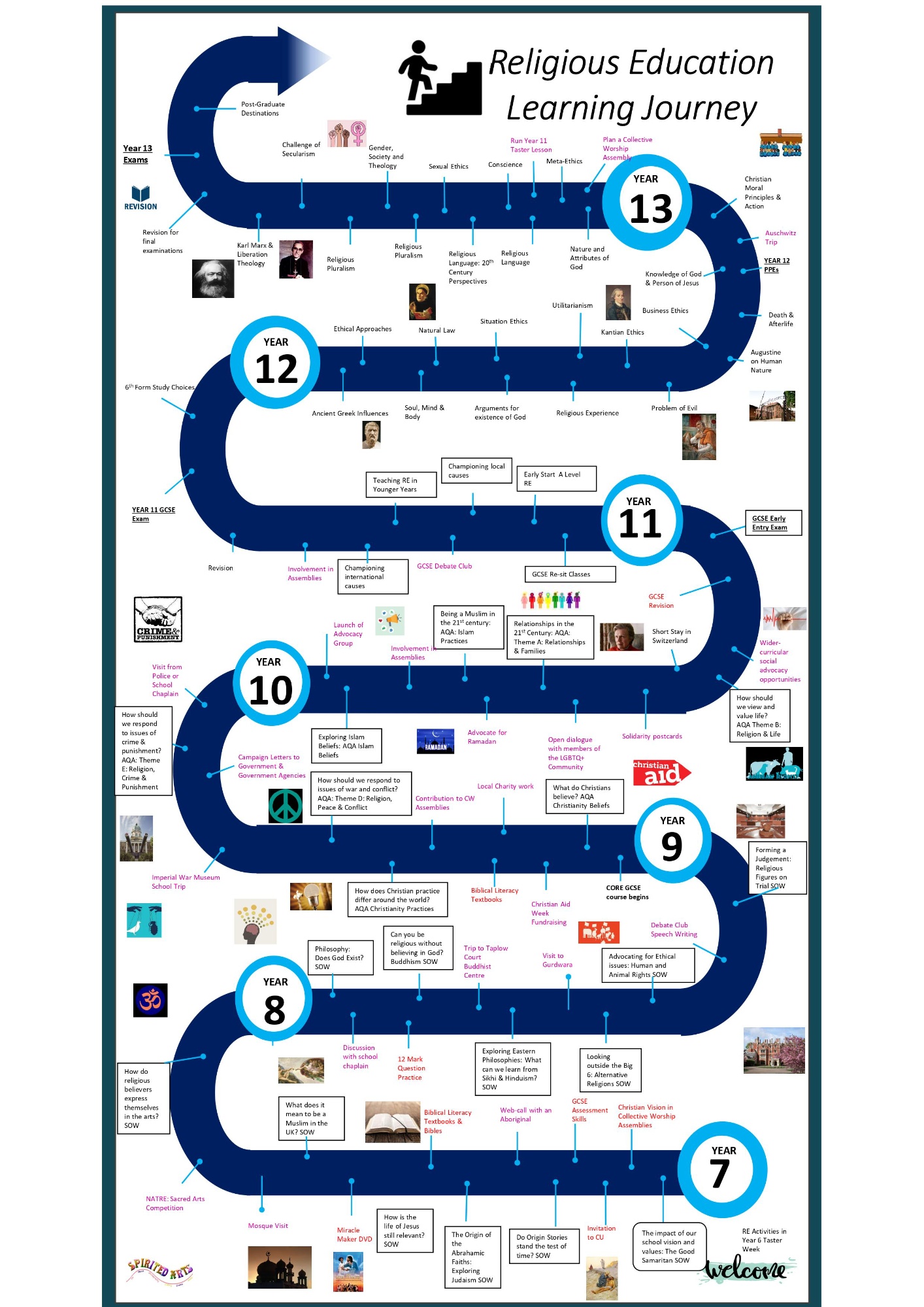
- We teach 2 distinctively Christian units in Year 7 - The Good Samaritan and the Life of Jesus. In year 8, pupils are introduced to Christian philosophical ideas on the existence of God, they contrast Christianity with Buddhism and Sikhism, and understand how other ‘alternative’ religions helped develop Christian thinking. Moreover, Year 8 pupils also study the ethics of Christianity related to animal rights, and put Jesus on trial. Year 9 pupils study the AQA GCSE units of Christianity Beliefs and Christianity Practices, and Year 10 students understand the diverse Christian responses to issues of relationships, crime and punishment, and life and death.
- In Year 7 pupils are introduced to the Biblical text, and it is used throughout the KS3 and GCSE lessons within the study of Christian theology, philosophy & ethics and the study of Judaism.
- The RE Curriculum is intrinsic to the establishment of the school’s Christian vision as we begin Year 7 with a unit exploring The Good Samaritan story - in its context for pupils individually, collectively, and creatively.
- The PRE curriculum is embedded with ample opportunity for social advocacy and reflection, as seen in the SOWs and curriculum implementation document
- The curriculum is well-balanced, pupils understand the difference and develop skills and knowledge in philosophy, theology and ethics
- Pupils have access to a wide range of professional resources, including: KS3 Explore RE Hodder textbooks, Biblical Literacy Hodder textbooks, the Miracle Maker DVD, AQA GCSE textbooks, 3 different OCR textbooks, and an in-department wider reading library.
Curriculum Implementation:
Year 7:
- How can our schools’ Christian vision and values be applied to everyday lives? Exploring the Good Samaritan story in Luke 10: 25 – 37
- Do Origin stories stand the test of time? Exploring Creation Myths
- Where did the Abrahamic faiths begin? Exploring Judaism
- How is the life of Jesus still relevant today? Exploring the impact of the life of Jesus
- What does it mean to be a Muslim in the UK? Exploring the faith of Islam and it’s meaning for Muslims in the UK today
- How do religious believers express themselves in art? Exploring the continuously changing relationship between religion and art
Year 8:
- Does God Exist? Exploring the Philosophical question of the existence of God
- Can you be religious without believing in God? Exploring Buddhism
- How should we form evaluative judgements? Exploring Religious Figures on Trial
- Does Religion exist outside of the big 6? Exploring Alternative Religions
- How do religious believers advocate for issues of human and animal rights? Exploring issues of human and animal rights
- What can we learn from the traditions of Sikhism and Hinduism? Exploring Sikh and Hindu Dharma
Year 9:
- What do Christians believe? AQA Spec A GCSE Christianity Beliefs
- How does Christian practice differ around the world? AQA Spec A GCSE Christianity Practices
- How should we respond to issues of war and conflict? AQA Spec A GCSE Theme D: Religion, Peace & Conflict
- How should we respond to issues of crime and punishment? AQA Spec A Theme E: Religion, Crime & Punishment
Year 10:
- What do Muslims believe? AQA Spec A GCSE Islam Beliefs
- How does Muslim practice differ around the world? AQA Spec A GCSE Islam Practices
- How should we respond to issues of relationships and families in contemporary British society? AQA Spec A GCSE Theme A: Relationships & Family
- How might our worldviews impact the way we see life and death? AQA Spec A Theme B: Religion and Life
- GCSE Exam Revision
Year 11:
In Year 11, pupils complete a Level 3 Award in General Religous Education, accredited by the National Open College Network. The course counts for 30 credits at Level 3 and earns each pupil valuable UCAS points.
The Assessment Objective Criteria of the course is as follows:
| 1 | Develop an understanding of spirituality, theology and ethics |
1.1 Compare and contrast the nature of spirituality, theology and ethics in how they manifest in society today 1.2 Critically discuss a current affairs issue by using spiritual and ethical principles |
| 2 | Understand the demands of religions commitment in everyday life | 2.1 Critically discuss the demands of religious commitment in everyday life |
| 3 | Reflect on questions of life |
3.1 Evaluate hwo the meaning of life and death are explained in at least two religious traditions 3.1 Relate their own bleifs regarding some questions of life to one religious tradition |
| 4 | Understand methods of engaging in religious practice | 4.1 Explain key elements of practice within religious faith |
| 5 | Understand different faith traditions within contemporary society | 5.1 Compare and contrast elements of three faith traditions commonly observed in contemporary society |
| 6 | Develop their own faith or belief position | 6.1 Justify their individual position with regards to a key issue within religious debate |
| 7 | Understand the relationships between religious belief, personal faith and lived experience | 7.1 Critically discuss relationships and tensions between religious belief, personal faith and lived experience in a specific context |
The Course is taught as follows:
|
Lesson title |
NOCN Assessment Criteria |
Activity |
|
Introduction
|
|
Course outline |
|
1. Moral Positions |
1.2 Critically discuss a current affairs issue by using spiritual and ethical principles. |
Reflection on Ethical Perspectives
Evaluation of a variety of controversial ethical events – medical ethics, nuclear weapons, truth, sexual ethics, theft |
|
2. Decisions |
1.1 Compare and contrast the nature of spirituality, theology and ethics in how they manifest in society today
1.2 Critically discuss a current affairs issue by using spiritual and ethical principles.
6.1 Justify their individual position with regard to a key issue within religious debate |
Who should be saved in the lifeboat? – Sanctity of Life, Quality of Life
Medical Ethics - Organ Donation: Who gets the kidney transplant?
Reflective Written Task |
|
3. NoseDive |
1.2 Critically discuss current affairs issues using spiritual and ethical principles
6.1 Justify your individual position concerning a key issue within religious debate.
7.1 Critically discuss relationships and tensions between religious belief, personal faith and lived experience in a specific context. |
Black Mirror Episodes
Reflective Written Task |
|
4. Philosophy, Theology & Ethics |
1.1 Compare and contrast the nature of spirituality, theology and ethics in how they manifest in society today
1.2 Critically discuss a current affairs issue by using spiritual and ethical principles
|
Mix and Match attitudes & responses
Group Discussion
Reflective written Task |
|
5 - 7. The Holocaust |
2.1 Critically discuss the demands of religious commitment in everyday life
7.1 Critically discuss relationships and tensions between religious belief, personal faith and lived experience in a specific context |
Critical Discussion
Reflective Written Task |
|
8. The Common Good |
2.1 Critically discuss the demands of religious commitment in everyday life
4.1 Explain key elements of practice within religious faith
5.1 Compare and contrast elements of three faith traditions commonly observed in contemporary society |
Critical Discussion
Case Study Reflection
Explanation
Evaluation |
|
9. Religious Tension |
2.1. Critically discuss the demands of religious commitment in everyday life.
3.2. Relate their own beliefs regarding some questions of life to one religious tradition.
7.1 Critically discuss relationships and tensions between religious belief, personal faith and lived experience in a specific context. |
Abortion: Reproduction Rights |
|
10 - 11. Questions of Life and Death |
3.1. Evaluate how the meaning of life and death are explained in at least two religious traditions.
3.2. Relate their own beliefs regarding some questions of life to one religious tradition.
5.1 Compare and contrast elements of three faith traditions commonly observed in contemporary society
8.1. Apply theological and ethical thinking skills to develop and evaluate a plan to respond to some likely life experiences in the future |
What is the meaning of life? Group Discussion Pair presentations & evaluation
Group Presentations on a variety of funeral rites & processions:
Ghanaian Coffin Art, Natural Tree Burials, Tibetan Sky Burials, Jewish funerals, Queen Elizabeth II’s funeral,
Reflective Tasks
Additional Film Suggestion: Soul or Coco |
|
12. Be Right Back |
1.2 Critically discuss current affairs issues using spiritual and ethical principles
6.1 Justify your individual position concerning a key issue within religious debate.
7.1 Critically discuss relationships and tensions between religious belief, personal faith and lived experience in a specific context. |
Black Mirror Episodes
Reflective Written Task |
|
13. Meditation |
2.1. Critically discuss the demands of religious commitment in everyday life.
4.1 Explain key elements of practice within religious
8.1 Apply theological and ethical thinking skills to develop and evaluate a plan to respond to some likely life experiences in the future
|
Practice a variety of meditation activities
Reflective Writing |
|
14. Write-Up Task |
8.1. Apply theological and ethical thinking skills to develop and evaluate a plan to respond to some likely life experiences in the near future |
Review of the course and PRE: Values for Living write up |
Year 12 Core PRE:
The curriculum for core PRE Year 12 was also designed through pupil responses to a Google Forms survey and the requirements of the Church of England statement of entitlement. Pupils receive 1 lesson a fortnight, in which they 3 questions of Theology, Philosophy & Ethics:
- Is Religion still important in contemporary Britain?
What does religion look like in Britain today?
The Rise of Atheism: Is Britiain losing faith?
How do religions promote good?
Religion and advocacy: how can we be Good Samaritans?
How has religion influenced pop culture?
- Engaging with big Philosophy questions:
How do we know we’re alive?
Is Utilitarianism the best policy for all actions?
What is the best form of government?
What is the meaning of life?
- Contemporary ethical issues of Justice, Injustice and Equality:
What is the meaning of justice of equality?
Is prejudice a problem in the UK?
Why is tolerance a necessary ‘British value’?
Do countries have a duty to support refugees?
Does the UK have a ‘gender’ issue?
To what extent is the UK an ‘equal’ society?
OCR A Level RE:
A-Level Religious Studies follows the OCR Syllabus which is split into 3 strands: Philosophy of Religion, Religion and Ethics, and Development of Christian Thought.
Year 12:
|
Philosophy |
Ethics |
Development of Christian Thought |
|
|
|
Year 13:
|
Philosophy |
Ethics |
Development of Christian Thought |
|
|
|
Links:
Pan Berkshire Agreed Syllabus:
https://wokingham.moderngov.co.uk/documents/s23390/Berkshire%20Syllabus%202018-2023.pdf
Church of England statement of Entitlement on Religious Education:
House of Commons Debate on Religious Education and the Freedom of Religion and Belief - June 2022
Religious Education in Modern Britian - Statement from the House of Commons - October 2022
https://commonslibrary.parliament.uk/research-briefings/cdp-2022-0182/